Doom! Doom! Thulsa Doom!
Conan the BarbarianThe chant "Doom! Doom! Thulsa Doom!" is the cultic war cry and liturgical refrain of the Cult of Set, a verbal weapon that binds Thulsa Doom's followers into a death-worshipping collective and serves as the narrative's recurring sonic signature of his power. It first appears as a chilling acclamation from the Vanir raiders who bow to Rexor, then resurfaces in Shadizar as a self-flagellating procession chants it, and finally becomes the hypnotic catechism through which Doom commands his votaries to kill. The phrase marks the collision between Conan's life-affirming Cimmerian ethos and Doom's death-cult, and its echoes structure the story's movement from the raid on the Cimmerian village to the final confrontation.
Origins and First Sounding
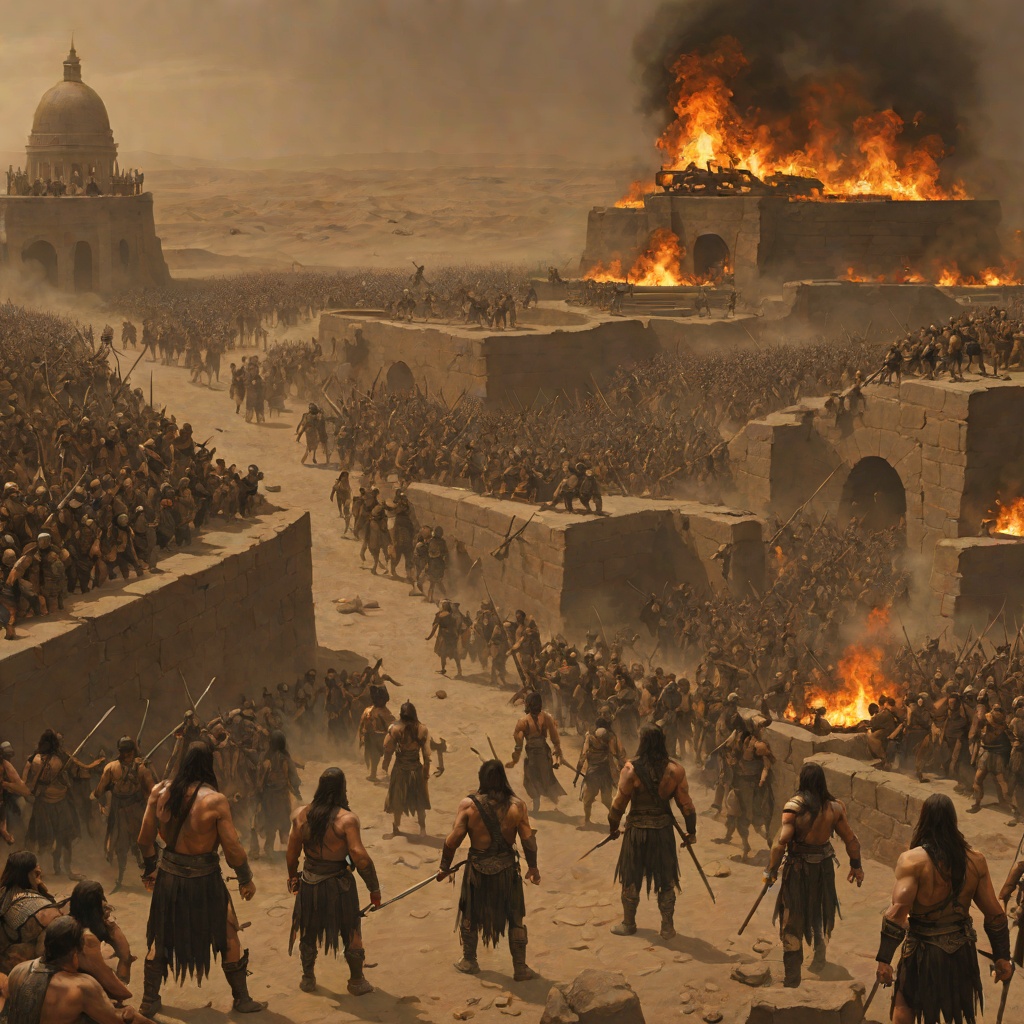
The chant enters the story at the moment of the Cimmerian village's destruction, when the mounted giant on the knoll — the commander of the marauders — picks his way down the slope along ruts of trampled snow stained with blood. As the grim apparition passes them, the Vanir raiders bow and give voice to an orchestrated chant: "Hail to Commander Rexor! Hail to Rexor! And to Doom... Doom... Tulsa Doom...." The misspelling of the name in the raiders' cry — "Tulsa Doom" rather than "Thulsa Doom" — suggests the chant is a raw, oral formula passed among barbarian raiders rather than a precisely learned liturgy. The chant functions here as a ritual of submission and hierarchy: the raiders first hail Rexor, the visible commander, then escalate to the unseen master whose name they invoke with a kind of dread reverence. The scene establishes that the phrase is not merely a name but a performative act of allegiance, spoken by those who have already bowed to the cult's power.
The Procession in Shadizar
The chant resurfaces years later in Shadizar of Zamora, where Conan, following the witch's promise that he will find what he seeks, watches a procession approach the Tower of the Black Serpent. As those in the lead prepare to enter the gaping doorway, a chant arises and floats back above the noises of the street: "Doom... Doom... Doom..." The young Cimmerian freezes in his tracks, confusion, fear, and a surge of anger contorting his face as the ominous chant awakens images long dormant in his memory. The marchers are young men, scarcely more than boys, who stagger along with faces blank and drained of colour, lashing their naked flesh with whips made of the hides of serpents and barbed with snakes' fangs, so that with each stroke their flesh is beaded with blood. Seemingly unaware of pain, they chant as they go: "Doom... Doom... Thulsa Doom... Thulsa Doom..." The scene reveals the cult's method of recruitment and control: it lures the young and innocent, who forsake husbands, sweethearts, and family to make love with serpents and mad priests. Subotai, spitting on the pavement, dismisses them as fools and madmen, snake-lovers, death-worshippers, noting that everywhere in these lands they rear dark towers, the citadels of Set. The chant here is inseparable from self-inflicted suffering — the flagellants' blood beads with each stroke — suggesting that the cult's power operates through the transformation of pain into ecstatic devotion.
The Liturgical Catechism
In the grand hall of the palace, the chant becomes a formal liturgical exchange between Thulsa Doom and his votaries. Doom steps forward, raises his arms majestically, then abruptly turns his palms down, and the chanting ceases upon the instant of the gesture. On the sepulchral silence that ensues, his resonant voice rises and falls like the tolling of a bell as he asks: "Who amongst you fears the warm embrace of death? When I, your father, ask it, will you take life for me? Will you strike true to the infidel heart, whether it be the heart of friend, or lover, or loved one in your former life?" Pausing, he turns his hypnotic gaze on the entranced faces, upturned in ecstasy, and they moan in response, swaying in rhythm to the beat of his utterances: "Doom! Doom!" The catechism continues with questions about slipping the silken noose over the heads of Set's enemies, staying true despite the blandishments of leaders, judges, and parents who have taught falsely, and clutching the hilts of daggers to spill the heart's blood of infidels. The chant thus operates as a call-and-response mechanism of ideological control, in which the votaries' repetition of the name constitutes their assent to murder. Doom's magnetic eyes dart from face to face and hold each follower in thrall, and the litany concludes with the promise that they will feel naught but joy when they perform their duty, growing in love of the Dark Master, the Wise Serpent, in whose coils lies eternal life — for the day of Doom is at hand, the day of the Great Cleansing.
The Chant and the Death Cult
The chant's power derives from its association with death-worship, a doctrine that Conan finds shocking and alien. When a merchant warns him that the servants of Set are deceivers who worship Death, Conan is shocked — to him, Death was ever the enemy. The merchant explains that they would murder their own parents, thinking to confer a boon by relieving them of the burden of life. This inversion of natural affection is the cult's core teaching, and the chant is its audible expression. King Osric, brooding over his wine cup, describes the cult's spread in terms that echo the chant's reach: snakes in his beautiful capital, black towers with black-hearted priests everywhere in Brythunia and Corinthia, stealing away children and turning them into monsters. The king's own daughter, Yasimina, has fallen under the spell of Thulsa Doom, and Osric fears she may bear a serpentine dagger pointed at his heart. The chant thus represents not merely a name but a whole system of inverted values — the worship of death over life, the murder of parents as a boon, the transformation of children into reptiles like the snakes they worship. Doom's demonstration in the garden makes this explicit when he commands a girl to leap from the wall to her death, then tells Conan: "That is strength, boy—that is power! It is strength against which the hardness of steel or the resilience of human flesh are as naught. What is steel, compared to the hand that wields it; what is the hand, without a mind to command it?" The chant is the verbal form of this power — the mind commanding the hand through the repetition of the master's name.
The Chant's Narrative Significance
The chant functions as the story's recurring sonic motif, marking the presence of the cult and the threat it poses. It first sounds at the destruction of Conan's village, awakening in him the memory of the raid that set him on his path of vengeance. It resurfaces in Shadizar at the moment Conan discovers the cult's fanatic worshippers, confirming that he has found the man or god or devil who bears the name of Doom. It becomes the liturgical framework of Doom's power in the palace hall, where the votaries' repetition of the name constitutes their submission. And it echoes in the cult's promise of the Great Cleansing, the day of Doom that will bring death to the infidels. The chant's trajectory mirrors the story's movement from Conan's childhood trauma to his final confrontation with the cult leader. The phrase "Doom! Doom! Thulsa Doom!" is thus more than a battle cry — it is the verbal embodiment of the death drive that the cult channels, the sound of a power that seeks to replace the natural bonds of family and love with the ecstatic submission to death. Against this chant stands Conan's own creed, learned from his father on a rocky ridge swept clear of snow: that the greatest secret of Crom is the secret of steel, a secret the gods taught not to men but jealously guarded in their inmost hearts. The chant of Doom and the secret of steel represent two opposed philosophies — the one seeking power through death and submission, the other through the forging of strength and the will to live. The narrative's resolution, in which Conan's steel ultimately prevails over Doom's cult, affirms the latter over the former, even as the chant's echoes linger as a reminder of the death-worship that the hero has overcome.